Slab Leak Water Damage in Hayward, CA
Warm spots, damp carpet and a meter that never stops point to a leak under the slab. The Hayward drying team lifts the wet flooring, dries the concrete and the walls, and documents the loss.
(888) 774-9605Talk to the Hayward drying team about a slab leak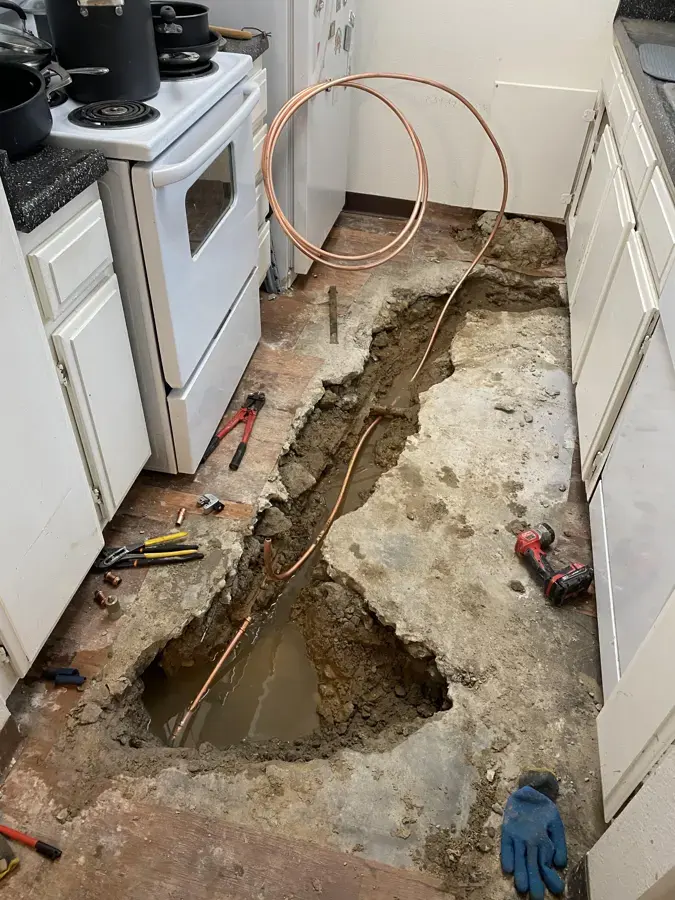
What to do the moment you find a slab leak
- Check the water meter
Turn off every fixture and watch the meter. If it still moves, a hidden leak is likely.
- Shut the main if water is visible
If water is surfacing through the floor, close the main valve until the line is repaired.
- Lift what you can
Move rugs, furniture and boxes off damp flooring so they stay dry.
- Photograph the floor
Take photos of damp spots, lifted seams and warm areas before any flooring is pulled.
Many of Hayward's postwar tract homes, from Harder-Tennyson to Glen Eden and Southgate, sit on concrete slabs with supply lines run underneath. When one of those lines leaks, the water has nowhere to go but up through the slab and sideways under the flooring.
What does slab leak water damage cost in Hayward, CA?
In Hayward, CA, slab leak water damage typically runs $1,500 to $7,000 for the restoration side, depending on how much flooring must come up, how far water spread and how long the concrete takes to dry.
- One room of flooring lifted
- Baseboards removed
- Slab drying
- Carpet, pad or laminate removed
- Flood cuts on walls
- LGR drying and logs
- Wide slab saturation
- Desiccant drying
- Extended drying days
What moves the number: how long the leak ran, the flooring type, how many rooms sit over wet concrete, wall wicking and whether desiccant drying is needed. The plumbing repair is separate.
For a closer planning range, try the water damage cost calculator. These are typical ranges, not quotes.
How a slab leak is handled in Hayward
IICRC S500 is the industry drying standard. It sets the order of the work, and the equipment stays until the readings say dry, not until the room looks dry.
- 01
Map the moisture first
The tech who does the walkthrough traces the source, then maps wet materials with thermal imaging and pinless meters before any equipment goes down.
- 02
Extract the standing water
The extraction crew pulls water with truck-mounted extraction, so it leaves the building instead of wicking into the next room.
- 03
Set the drying to the room
The drying team places air movers to each room's evaporation load and runs LGR dehumidifiers, with desiccants for Class 4 materials.
- 04
Verify dry, then document
Most crews log readings daily and pull equipment once wet materials sit within 2 to 4 points of a dry reference material.
Signs of a slab leak in a Hayward home
- A warm spot on the floor, often from a hot water line
- Damp or darkened carpet, or laminate that lifts at the seams
- The sound of running water with every fixture off
- A water meter that keeps turning when nothing is in use
- A water bill that jumps without an obvious cause
East Bay clay soils shrink in the dry summer and swell in the wet winter. That seasonal movement, plus the age of the copper in homes built between the 1950s and the 1970s, is why slab leaks are a steady call in the central and south flatlands.
What the drying team does after the leak is found
A leak detection plumber locates and repairs the line, either by opening the slab or by rerouting the pipe through the walls or attic. The restoration crew handles the water damage around it.
The tech who does the walkthrough maps moisture across the slab and up the base of nearby walls. Carpet pad, laminate and engineered flooring over a wet slab usually come up so the concrete can breathe. Baseboards come off, and a flood cut may open the bottom of walls that wicked water.
Concrete dries slowly. The drying team runs LGR dehumidifiers and air movers across the slab, and in hard cases uses desiccant dehumidifiers for the dense, Class 4 material. Readings are logged daily until the slab and framing meet the drying goal.
Trade fact: new flooring laid over a slab that is still wet can cup, lift or grow mold underneath. The flooring goes back only after the concrete readings match a dry reference.
Documentation for a slab leak claim
Policies often treat the pipe repair and the resulting water damage differently. A clean claim file shows the moisture map, the daily readings, photos of the opened slab and the category and class of the loss.
For water-saving leak checks, see the EPA WaterSense leak page, and for moisture control at home, the Department of Energy moisture control page. See also structural drying.
Slab Leak Water Damage coverage across Hayward
The restoration team handles a slab leak in every Hayward ZIP and the neighboring East Bay communities.
The Hayward restoration crew handles a slab leak across Downtown, Burbank, Mount Eden, Tennyson, Schafer Park and the Hayward Highlands, plus Castro Valley, San Lorenzo and San Leandro.
ZIP codes 94540, 94541, 94542, 94543, 94544, 94545 and 94557 are all covered.
See every neighborhood and ZIP coveredSlab Leak Water Damage questions in Hayward, CA
Does the restoration crew fix the pipe?
No. A plumber locates and repairs the leak. The restoration crew removes wet materials, dries the slab and walls and documents the water damage.
Why does wet flooring have to come up?
Flooring over wet concrete traps moisture. Lifting carpet pad, laminate or engineered wood lets the slab dry and prevents mold underneath.
How long does a wet slab take to dry?
Longer than drywall or carpet. A small area can dry in several days; a saturated slab can take a week or more with desiccant dehumidifiers.
Can tile stay in place?
Sometimes. Tile set on a slab can often stay if the grout lines and edges allow drying and readings improve. The drying team decides from the meter, not by eye.
Why are slab leaks common in Hayward?
Many homes built from the 1950s to the 1970s have copper lines under the slab, and East Bay clay soils swell and shrink with the seasons, which stresses those lines.
Is slab leak damage covered?
Many policies separate the cost of reaching and repairing the pipe from the water damage it caused. Coverage depends on your policy, so it is worth checking with your own insurer.
Slab Leak Water Damage in Hayward? Call before it spreads.
The longer water sits, the further it wicks into drywall, subfloor and framing. The Hayward water damage pros answer day or night.